Monday, May 4, 2020

Saturday, May 2, 2020
A Trust Fall

A lot has been written about the agriculture age, the industrial revolution, spurt in the service sector, information age, knowledge age, and Industry 4.0. However, it is important to note that we are completing a full circle. The farmers, the carpenters, the goldsmiths of the pre-industrial age were self-employed. The education system of the 1900s was designed to create obedient employees. People who did not like to make mistakes, and who did not ask questions. The demerits of our education system are highlighted by Sir Ken Robinson in his book – The Element.
We have been brainwashed to believe that security is more important than freedom. Human beings learn from mistakes, and our education system punishes us for making mistakes. It makes us compete with each other for grades. Then when we step out in the real world, we are taught that it is important to cooperate and collaborate. This contradiction exists at every level. Our economic theories focus on the shortage of resources, and the need for controlling people and resources rather than creating value.
Our education system will not allow us to develop our entrepreneurial skills. It is, therefore, important that we do it ourselves. Here are a few things, we parents can do:
- Give our kids the freedom to think and choose. Let them make mistakes and learn from them.
- Many things can be done without money (resources). We need to encourage our kids to take up assignments that can enhance their skills (social work for example).
- Discussing with our kids about opportunities rather than pointing out the shortage of resources.
- Letting them get involved in team events.
- Making them responsible for their choices.
Things are fundamentally changing. Secure high paying jobs are bound to diminish. Wages are going to stagnate. It is, therefore, important to develop the entrepreneurship mindset in our children. Some of you would have heard of the trust fall. It is a team-building exercise in which a person deliberately allows themselves to fall, trusting the members of a group to catch them. It is important that we as parents, create that safety net for our children.
- Subodh Gadgil (May 2, 2020
Monday, April 27, 2020
Some useful links of short courses
Lockdown is not easy for many of us. Yet, I am trying to make use of my time to learn things that awed me but I side-casted as I couldn't find enough time. I can no longer procrastinate.
Mindmap - a wonderful short course by Tony Bonaz himself. I could play the videos at a speed of 1.5X as I knew some things already.
Read 100 Books a year - a free weekend workshop by Pavan Bhattad that changed my thoughts on speed reading and memory building I have been following from other sources.
freepdfconvert.com - one of the most wonderful lifetime subscription that pays off regularly in my work and studies both. It's one of the very few handy tools that makes me quicker than many others around.
LinkedIn Education - Some wonderful techno-managerial courses I came across, admired, shared, and bookmarked.
Business Law for Managers - Jo-Ná A. Williams
SQL Tips, Tricks, & Techniques - Ben Sullins
Tableau and R for Analytics Projects - Curtis Frye
Enterprise Architecture in Practice - David Swersky
Mindmap - a wonderful short course by Tony Bonaz himself. I could play the videos at a speed of 1.5X as I knew some things already.
Read 100 Books a year - a free weekend workshop by Pavan Bhattad that changed my thoughts on speed reading and memory building I have been following from other sources.
freepdfconvert.com - one of the most wonderful lifetime subscription that pays off regularly in my work and studies both. It's one of the very few handy tools that makes me quicker than many others around.
LinkedIn Education - Some wonderful techno-managerial courses I came across, admired, shared, and bookmarked.
Business Law for Managers - Jo-Ná A. Williams
SQL Tips, Tricks, & Techniques - Ben Sullins
Tableau and R for Analytics Projects - Curtis Frye
Enterprise Architecture in Practice - David Swersky
Exploring Infographics -
Learning new words used in SMS.
Making most of this lockdown@home.
Business Law for Managers
Business Law for ManagersBusiness Law for Managers
Business Law for Managers
Friday, April 10, 2020
Sunday, April 19, 2015
PMP - draw all i/o in a go..
It takes more than 3 hour to be able to make a 3 min ITTO chart in exam and before that of course ..
Hope you know how to draw an every day chart for PMP study -
http://withinaccess.blogspot.in/2015/04/itto-3-minute.html
Once u r used to this chart , u wouldn't even need to write short names of 47 processes.. only their placeholders will be enough...
Now come to Rita Mulcahy's advice to start with o/p and then i/p which makes the o/p and finally the items (tools) needed to convert the i/p to the o/p..
as you can recall all 47 names now, do u think how easy would be to recall almost all the o/p for 47 processes?
why don't u make the chart of 47 processes on 3 A4 size sheets and start recollecting the o/p for all of them in whichever sequence you can? Hint - pick any column at a time..say I then C then P and then E and at last M...
initially u can refer to PMBOK index in the link I mentioned above...
Once u r good at writing o/p for all 47 processes.. your brain will automatically assign o/p to the short process name..and it will be effortless in just 3 attempts max..
After that u have to repeat same process for i/p but this time u ll recollect o/p name and try to write i/p that make that o/p.. this time u don't write o/p names at all...
again u ll use 3 sheets of A4 size..
at the end of the exercise, u ll come up with something like below images..-
don't bother to read them, just make ur own..

You can leave common i/p and o/p in the process as I did..
here's the list you can ignore -
etc.
there're some shortcuts for all of these..and without that shortcut it's difficult to recollect them in exam..
there are shortcuts for everything that looks hard in drawing i/o in above processes...so don't lose heart if 3 attempts don't seem enough for a few of them...
For shortcuts you can refer to Andy Crowe's site (it's paid but u can get 7 days free access on buying his book...7 days aren't enough for those many shortcuts and unlimited questions that resemble exam ones)
Btw did u notice most of the time, there was a link as o/p of one process was forming i/p of another...only some of the i/p were new...which were they?
Here's a list -
etc. as you can guess they are coming from outside world of the 47 processes..
Hope you know how to draw an every day chart for PMP study -
http://withinaccess.blogspot.in/2015/04/itto-3-minute.html
Once u r used to this chart , u wouldn't even need to write short names of 47 processes.. only their placeholders will be enough...
Now come to Rita Mulcahy's advice to start with o/p and then i/p which makes the o/p and finally the items (tools) needed to convert the i/p to the o/p..
as you can recall all 47 names now, do u think how easy would be to recall almost all the o/p for 47 processes?
why don't u make the chart of 47 processes on 3 A4 size sheets and start recollecting the o/p for all of them in whichever sequence you can? Hint - pick any column at a time..say I then C then P and then E and at last M...
initially u can refer to PMBOK index in the link I mentioned above...
Once u r good at writing o/p for all 47 processes.. your brain will automatically assign o/p to the short process name..and it will be effortless in just 3 attempts max..
After that u have to repeat same process for i/p but this time u ll recollect o/p name and try to write i/p that make that o/p.. this time u don't write o/p names at all...
again u ll use 3 sheets of A4 size..
at the end of the exercise, u ll come up with something like below images..-
You can leave common i/p and o/p in the process as I did..
here's the list you can ignore -
- CR (with any prefix)
- WPI and WPD
- OPA
- EEF
- project document updates
etc.
there're some shortcuts for all of these..and without that shortcut it's difficult to recollect them in exam..
there are shortcuts for everything that looks hard in drawing i/o in above processes...so don't lose heart if 3 attempts don't seem enough for a few of them...
For shortcuts you can refer to Andy Crowe's site (it's paid but u can get 7 days free access on buying his book...7 days aren't enough for those many shortcuts and unlimited questions that resemble exam ones)
Btw did u notice most of the time, there was a link as o/p of one process was forming i/p of another...only some of the i/p were new...which were they?
Here's a list -
- Project SOW
- Business Case
- Seller Proposals
- Agreements
etc. as you can guess they are coming from outside world of the 47 processes..
Saturday, April 18, 2015
PMP - A handy chart for everyday study
One of the confidence boosting exercise I did was to be able to draw ITTO in less than 3 minutes in exam hall. Here's how I did it but before that I would tell you why it was beneficial?

After you have short names for 10 KA's + 5 PG's + 47 processes, you can start with how to draw the process chart -
http://withinaccess.blogspot.in/2014/11/process-chart.html
please read above links only once and keep doing the stuff with paper and pen.. next time refer to only ur notes...else u'll not gain much from the processes mentioned here.
After about 3 times of making the process chart, you must be able to draw something like below image every time u start studying for ur PMP -


1. It would save my time and energy for other important aspects of PMP studies.
2. It would build my confidence and avoid confusion during studies and exam both.
So lets get started-
You won't be able to do it in exam unless you're used to it.
So start doing this every time you study for PMP i.e. if you study for PMP every day, draw it every day - as simple as that.
How?
This image is an example of my one day's study where I started my PMP day with six A4 papers and fill in the keywords in 47 placeholders.
Mostly I would use single A4 paper for one day's studies and later I started using single big chart that's attached to fill in all clubbed up details under one big sheet for reference.
Reading or copying this sheet is of no use as that's only one way to to do the right thing..
With the process I am mentioning here you'll devise your own way to do it better.
Do you still call all 47 processes by their full names?
If yes, you're wasting your time. Once I know the full name, I can give them a short name and slowly my brain would start joining the short names with the full names. I write short name to save my time and call full name in brain as I will see full names in real world questions.
So the first hint to make ITTO in 3 minutes is to write short names of 10 KA's, 5 PG's and 47 processes.
If you dunno what short names to give all these stuff. Pls read this -
http://withinaccess.blogspot.in/2014/11/the-47-processes-1st-headache.html
If you dunno what short names to give all these stuff. Pls read this -
http://withinaccess.blogspot.in/2014/11/the-47-processes-1st-headache.html
After you have short names for 10 KA's + 5 PG's + 47 processes, you can start with how to draw the process chart -
http://withinaccess.blogspot.in/2014/11/process-chart.html
please read above links only once and keep doing the stuff with paper and pen.. next time refer to only ur notes...else u'll not gain much from the processes mentioned here.
After about 3 times of making the process chart, you must be able to draw something like below image every time u start studying for ur PMP -
Initially, there could be mistakes, so make sure that process counts are right in each column as - 2-24-8-11-2 respectively.
let's talk in shortcuts now -
[It's good to count number of processes in each KA as well but only if you remember PG=P's count then also it's enough.. e.g.-P has 3-4-5-6 processes in C1,S1,R and T respectively..otherwise just 1...whenever it has more than 1, E's have none..E is 3 for H...hence there is none in it's M...M is 2 for I and S1...(hope u know which 2-2 are I and C)]
making above chart isn't enough...read aloud each of the short forms as their full forms .. use short forms only to write...never to call or recall
there could be no better description than Kim's study guide for beginners and no complete reference than PMBOK itself on ITTO..so for quick reference I had created an index for jumping to any of the processes I wished to -
I used same chart to create the index also
This is how I used that small chart for every little thing I did on a single day..
Get used to the chart and the short names and u ll save urself a lot of time and freedom from all sorta confusions
Wednesday, April 1, 2015
ITTO - excel
If you're looking for ITTO in spreadsheet, here's the link -
http://pmzilla.com/i-created-itto-5th-ed-spreadsheet
Hope this helps you, I did not use it though.
You can use it for -
http://pmzilla.com/i-created-itto-5th-ed-spreadsheet
Hope this helps you, I did not use it though.
You can use it for -
- memorizing ITTO
- creating your shortcuts and to be sure you're covering complete stuff
- answering PMP mock questions online during your preparations
Practice with PM's
I wish I knew it before I studied for PMP, nevertheless I'm sharing it here for you -
Know about - PMChallenge and PMwars?
Register on this site -
(or use FB/PMI credentials)
http://www.projectmanagement.com/
Although you can do many things there but from exam's perspective, you can answer questions on link -
http://www.projectmanagement.com/PMchallenge/
You can access above link without registering, but to keep track of your score and already answered correct questions, you must login with your own id.
To encourage yourself, you'll earn badges by answering some specific no. questions.
Tip - I use snipping tool to grab all wrong answers so that I can go through them later.
If you want to verify how you're doing you can get into PMwars and choose someone like you (novice at beginning and later a master). With PMwars you'll have to memorize answers so that you can score higher than your opponent. It's fun.
For PMwars you must login.
Know about - PMChallenge and PMwars?
Register on this site -
(or use FB/PMI credentials)
http://www.projectmanagement.com/
Although you can do many things there but from exam's perspective, you can answer questions on link -
http://www.projectmanagement.com/PMchallenge/
You can access above link without registering, but to keep track of your score and already answered correct questions, you must login with your own id.
To encourage yourself, you'll earn badges by answering some specific no. questions.
Tip - I use snipping tool to grab all wrong answers so that I can go through them later.
If you want to verify how you're doing you can get into PMwars and choose someone like you (novice at beginning and later a master). With PMwars you'll have to memorize answers so that you can score higher than your opponent. It's fun.
For PMwars you must login.
Team Building - Bruce Tuckman - 5 stages
In short -

Dr Bruce Tuckman published his Forming - Storming - Norming - Performing model in 1965. He added a fifth stage, Adjourning, in the 1970s.
Forming -
Team is formed..
Team begins to address ...
Storming -
place for conflicts, arguments ..
Every-time a new member joins the cycle of team building phases starts from here..
Norming -
Team begins to perform..
Performing -
Self-motivated, continuous performing stage..
Adjourning -
Emotional c-off..
Here's a good link to refer to -
http://www.businessballs.com/tuckmanformingstormingnormingperforming.htm
P.S.- Read again only italics this time. They will help you answer questions quickly.
For details, pl refer to other stuff as this article is helpful only for those who are aware of the concept and just wish to memorize it to be correct while choosing correct option in multiple choice question.
(Pl add any important keywords if I left)
Dr Bruce Tuckman published his Forming - Storming - Norming - Performing model in 1965. He added a fifth stage, Adjourning, in the 1970s.
Forming -
Team is formed..
Team begins to address ...
Storming -
place for conflicts, arguments ..
Every-time a new member joins the cycle of team building phases starts from here..
Norming -
Team begins to perform..
Performing -
Self-motivated, continuous performing stage..
Adjourning -
Emotional c-off..
Here's a good link to refer to -
http://www.businessballs.com/tuckmanformingstormingnormingperforming.htm
P.S.- Read again only italics this time. They will help you answer questions quickly.
For details, pl refer to other stuff as this article is helpful only for those who are aware of the concept and just wish to memorize it to be correct while choosing correct option in multiple choice question.
(Pl add any important keywords if I left)
Tuesday, November 11, 2014
Process Chart
Do you get confused about the activity names in the options to pick the right one?
Do you get confused in picking the right KA or PG for a given activity name or vice versa?
Do you get confused about how many processes per PG or KA?
Do you feel memorizing the Process Chart might help you?

But what if something is not made/built/implemented i.e. "E" as planned i.e. "P"? We will find out about such misses in "M" and need to return to "E" from there instead of closing "C". Hence the arrow 5
e.g.:- Perf. QA is an "E" process that's carried out before and after Control Q which is an "M" process.
So QA to QC arrow 3 and QC to QA arrow 5
What if Plan itself needs to be carried out once again? Plan could also be faulty or something was missed to be Planed and hence to be implemented subsequently? We will again find this out in "M" and the completed process will start from "P" this time. Hence the arrow 6.
e.g.:- An approved CR might require planning again so might follow arrow 6.
First time right deliverable will follow arrows 2-3-4 only.
As we will study PG-wise, and #PG < #KA, its easier to draw..
Can you simply list out the PG's in columns and KA's in rows.. (sequence is given at link mentioned above)
PG seq - I,P,E,M,C
KA seq - TC1S1, HS2C2, PQR, I
(This KA sequence will also help in some internal sequencing you ll come across, so better don't divert from this one)


E -
Don't take Risk of Executing TCS cuz of HR++
i.e. no R,T,C1,S1..means we have (10-4=) 6 KA's under column "E"
So please cross (or color) the boxes where you are not putting any process names.
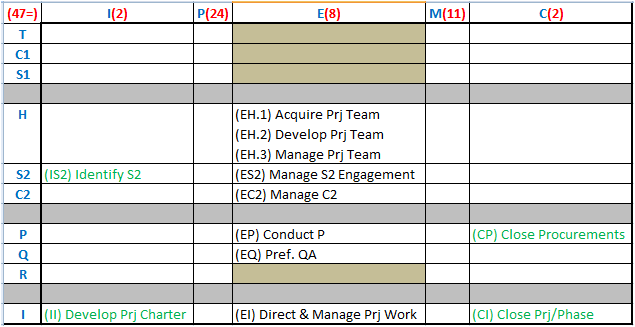
As we know E has 8 processes cuz of double pluses in HR -
Now please put the numbering (in brackets) first..and then start writing the names -
Signature verb of this PG is Manage, (Direct & )Manage..
So you need to remember only these verbs -
H is "Acquired" (this verb is used only here in "E") and "Developed" (this verb is in "I" and "P" as well) both.
Procurement is "Conducted" (this verb is used only here in "E")
QA is "Performed" (perf. verb has been used in M as well once)
Do u also notice an "Engagement" after S2, it happens in "M" as well
M -
Signature verb of this PG is Control, M (Monitor & Control)..
Cuz of IS1
i.e. I and S1 both have an additional processes making (9+2=) 11 processes in "M"
Those 2 additional ones are very imp too-
Validate S1 - (brings the Deliverable)
Perf. ICC - Integrated Change Control (digests the CR's to work upon)

Did you notice "Schedule" noun for "Time".
Remember no option with noun-"Time" or verb "Execute" is correct in exam.
What comes to your mind first when you hear "Time management" or "Execution" :? Nothing related to PMP, right?
P -
Now remains the biggest task
Distributing 24 among 10 KA's is difficult.
Lets distribute with partiality in this sequence and weightage -
This time take the Risk of doing so for TCS -
i.e. R-5,T-6,C-3,S-4. Just remember this as is
and number the sequences in the boxes
Name 1st processes in each KA as -
Plan <KA> Management.
Only for Time, KA is replaced with noun - Schedule

Now recall the nouns (and unique verbs) under each KA and don't forget the sequence of processes within the P PG -
Like for PC1.# -
First Costs of Activities are Estimated and then overall Budgeting is done.
 Did you notice last P activities are also significant as they mostly create Baselines (T1C1S1-Cost, Schedule,Scope) or there's a repeated "Plan" verb where we actually work on Risks..
Also notice that the big colored boxes are not double in any row?
That's cuz if one KA has multiple processes in a PG, then it either skips some of the other PG's or has only 1 processes in other PG's
Also when u c a shortcut, do u read the full name? I do.
Can u try making this chart by urself once while reading and 2nd time by recalling the steps..third time u can do it on ur own.
Do you get confused in picking the right KA or PG for a given activity name or vice versa?
Do you get confused about how many processes per PG or KA?
Do you feel memorizing the Process Chart might help you?
Do you feel remembering the sequence of process could have helped you in some way?
Actually memorizing the process chart is not helpful in any of these as the headache of memorizing and heartbeats of recalling are not worth above questions...and with some days of studies you'll automatically get used to all of them.
If you still face issues, this post is for you...
Have you gone through below post for some other types of answers on verbs (PG) and nouns (KA)
We will extend similar shortcuts here and there are multiple references to above link.
Below is Kim's PG sequencing diagram -
As the Diagram says, the processes in 5 PG's have a proper sequence (1 to 4, green arrows and numbering)
But what if something is not made/built/implemented i.e. "E" as planned i.e. "P"? We will find out about such misses in "M" and need to return to "E" from there instead of closing "C". Hence the arrow 5
e.g.:- Perf. QA is an "E" process that's carried out before and after Control Q which is an "M" process.
So QA to QC arrow 3 and QC to QA arrow 5
What if Plan itself needs to be carried out once again? Plan could also be faulty or something was missed to be Planed and hence to be implemented subsequently? We will again find this out in "M" and the completed process will start from "P" this time. Hence the arrow 6.
e.g.:- An approved CR might require planning again so might follow arrow 6.
First time right deliverable will follow arrows 2-3-4 only.
Creating process chart in 7 steps-
*****************************
(This method will require 1-2 time revision to be able to draw it on ur own)As we will study PG-wise, and #PG < #KA, its easier to draw..
Can you simply list out the PG's in columns and KA's in rows.. (sequence is given at link mentioned above)
PG seq - I,P,E,M,C
KA seq - TC1S1, HS2C2, PQR, I
(This KA sequence will also help in some internal sequencing you ll come across, so better don't divert from this one)
By now, you must be knowing there are total 47 process across 5 PG's (and 10 KA's but we are concentrating on PG-wise distribution)
So how many processes per PG?
2-2 in I and C (first and last PG's)
(2*2*2=) 8 in E (i.e. in middle PG)
('1'||'1'=11) in M
(8*3 =) 24 in P
Can you try to put the numbers like this by just remembering above description?
(Hope you still remember verbs and noun funda mentioned in above link)
For sequencing 47 processes we used format
<PG><KA>[.#]
I and C -
Just remember (2*2 =) 4 process names and place them against their KA's
Id (Identify) Stakeholder
Develop Prj Charter
Close Procurement
Close Prj or Phase
Don't take Risk of Executing TCS cuz of HR++
i.e. no R,T,C1,S1..means we have (10-4=) 6 KA's under column "E"
So please cross (or color) the boxes where you are not putting any process names.
As we know E has 8 processes cuz of double pluses in HR -
Now please put the numbering (in brackets) first..and then start writing the names -
Signature verb of this PG is Manage, (Direct & )Manage..
So you need to remember only these verbs -
H is "Acquired" (this verb is used only here in "E") and "Developed" (this verb is in "I" and "P" as well) both.
Procurement is "Conducted" (this verb is used only here in "E")
QA is "Performed" (perf. verb has been used in M as well once)
Do u also notice an "Engagement" after S2, it happens in "M" as well
M -
Signature verb of this PG is Control, M (Monitor & Control)..
Each KA is Monitored except H, cuz H had enough (++) in E already.
Lets color its box and don't put anything made-up of imagination here ;-P
So we should have (10-1=)9 processes in M whereas we have 11.
i.e. I and S1 both have an additional processes making (9+2=) 11 processes in "M"
Those 2 additional ones are very imp too-
Validate S1 - (brings the Deliverable)
Perf. ICC - Integrated Change Control (digests the CR's to work upon)
Did you notice "Schedule" noun for "Time".
Remember no option with noun-"Time" or verb "Execute" is correct in exam.
What comes to your mind first when you hear "Time management" or "Execution" :? Nothing related to PMP, right?
P -
Now remains the biggest task
Distributing 24 among 10 KA's is difficult.
Lets distribute with partiality in this sequence and weightage -
This time take the Risk of doing so for TCS -
i.e. R-5,T-6,C-3,S-4. Just remember this as is
and number the sequences in the boxes
Name 1st processes in each KA as -
Plan <KA> Management.
Only for Time, KA is replaced with noun - Schedule
Now recall the nouns (and unique verbs) under each KA and don't forget the sequence of processes within the P PG -
Like for PC1.# -
First Costs of Activities are Estimated and then overall Budgeting is done.
Also notice that the big colored boxes are not double in any row?
That's cuz if one KA has multiple processes in a PG, then it either skips some of the other PG's or has only 1 processes in other PG's
Also when u c a shortcut, do u read the full name? I do.
Can u try making this chart by urself once while reading and 2nd time by recalling the steps..third time u can do it on ur own.
Sunday, November 9, 2014
Some useful links
For some of the links you might need to register or avail the paid membership -
Do you wonder how the real documents look like, the ones mentioned throughout PMP study materials and books? May be they help you remember what do they contain when such a question is asked in the exam -
http://www.pmi.org/Learning/electronic-forms.aspx
Looking for tests or exam questions?
Do u know best way to prepare by questions is see - check the ans after each question and not doing this as a whole?
But for mock test of course you should try the whole test in a go before checking the ans.
http://pmi.books24x7.com/toc.aspx?bookid=55550
Do you wonder how the real documents look like, the ones mentioned throughout PMP study materials and books? May be they help you remember what do they contain when such a question is asked in the exam -
http://www.pmi.org/Learning/electronic-forms.aspx
Looking for tests or exam questions?
Do u know best way to prepare by questions is see - check the ans after each question and not doing this as a whole?
But for mock test of course you should try the whole test in a go before checking the ans.
http://pmi.books24x7.com/toc.aspx?bookid=55550
Saturday, November 8, 2014
New lines of Communication
Considering we should solve a question in 1 minute and also by 1 read (to not to procrastinate later about time insufficiency); we should have some shortcuts for typical problems..
Suppose you have 3 new members added to a team of 7, and you gotta find out no.of communication channels added?
Are you gonna solve this way -
Formula = n(n-1)/2
Total members now = 7+3 = 10
10(10-1)/2 - 7(7-1)/2 = 5*9 - 7*3 = 45 - 21 = 24
Hope you found out a trick that there is a division by 2 but also two consecutive numbers in numerator as n and n-1 one of which is gonna be divisible by two..and you must perform division before multiplication as we gotta play with small numbers as much as possible..
Here's my real trick..the new formula ..
m(m-1)/2 +nm
m is added mem n is original mem
3(3-1)/2+3*7=3+21=24
I used the example so that you don't need to remember the formula..
Happy Calculating!
Suppose you have 3 new members added to a team of 7, and you gotta find out no.of communication channels added?
Are you gonna solve this way -
Formula = n(n-1)/2
Total members now = 7+3 = 10
10(10-1)/2 - 7(7-1)/2 = 5*9 - 7*3 = 45 - 21 = 24
Hope you found out a trick that there is a division by 2 but also two consecutive numbers in numerator as n and n-1 one of which is gonna be divisible by two..and you must perform division before multiplication as we gotta play with small numbers as much as possible..
Here's my real trick..the new formula ..
m(m-1)/2 +nm
m is added mem n is original mem
3(3-1)/2+3*7=3+21=24
I used the example so that you don't need to remember the formula..
Happy Calculating!
Quality - always bad?
I devised a technique to answer all question write of below types -
Quality or Grade?
Don't you think we had been using one term Quality for even Grade as well in past? That's why our answers go wrong. Never mind here's a simple definition -
Quality is "minimum" stuff that solves the purpose (a laptop with a warranty even without stated is a universal purpose nowadays) and especially when customer has specified it (a black laptop instead of a white one is bad quality)
As I said Quality is minimum,you can't accept anything below that...
Anything above it is - Grade...
Maths student?
Grade is Quality ++
Prevention or Inspection?
Assurance or Control?
First get your definitions clear.. first of both the groups fall in - E
Latter in both the groups fall in - M
If you have seen Kim's PG link diagram you will know M can go back to any of P or E while other PG's are always in a queue I -> P -> E -> M -> C
So M can go back to E means QA comes before and after both QC..
Their tools are same and by tool name u can't guess the answer right.
So?
As I said get the definitions right...at least the oxford dictionary ones....for all 4 words..
And remember which pair falls into E and which pair falls into M?
CTC
-----
Replace the verb in punchline with any of the 4 words u r sure of the meaning and category (E or M)... if meaning did not change, you got the answer.. if meaning changed , the other one is right...
I found no exception so far for this trick and later i started understanding the real concept without the trick mentioned here...
Only sometimes I felt answer was near right... but it turned out to be absolutely right...
I hope Quality will never be too bad now :-)
Quality or Grade?
Don't you think we had been using one term Quality for even Grade as well in past? That's why our answers go wrong. Never mind here's a simple definition -
Quality is "minimum" stuff that solves the purpose (a laptop with a warranty even without stated is a universal purpose nowadays) and especially when customer has specified it (a black laptop instead of a white one is bad quality)
As I said Quality is minimum,you can't accept anything below that...
Anything above it is - Grade...
Maths student?
Grade is Quality ++
Prevention or Inspection?
Assurance or Control?
First get your definitions clear.. first of both the groups fall in - E
Latter in both the groups fall in - M
If you have seen Kim's PG link diagram you will know M can go back to any of P or E while other PG's are always in a queue I -> P -> E -> M -> C
So M can go back to E means QA comes before and after both QC..
Their tools are same and by tool name u can't guess the answer right.
So?
As I said get the definitions right...at least the oxford dictionary ones....for all 4 words..
And remember which pair falls into E and which pair falls into M?
CTC
-----
Replace the verb in punchline with any of the 4 words u r sure of the meaning and category (E or M)... if meaning did not change, you got the answer.. if meaning changed , the other one is right...
I found no exception so far for this trick and later i started understanding the real concept without the trick mentioned here...
Only sometimes I felt answer was near right... but it turned out to be absolutely right...
I hope Quality will never be too bad now :-)
Tuesday, November 4, 2014
Begin here! (Wisdom Pearl links)
Curtsy Albert.Joseph@simplilearn.com, I just came across 7 wonderful tips to do the PMP preparation -
http://www.simplilearn.com/7-tips-to-prepare-for-pmp-certification-exam-rar243-article
When I went through it today, I felt that's exactly what a person needs to know while studying...especially first 5 tips are what I followed and got wonderful returns in less time...
*******************************************************************
Curtsy Sreejannortel@gmail.com, we have other useful links here to start with -
How To Avoid An Audit Of The PMP Application Process? | The Wisdom Pearls
http://thewisdompearls.com/avoid-a-pmp-application-audit/
Best Tips To Pass The PMP Exam On First Attempt | The Wisdom Pearls
http://thewisdompearls.com/best-tips-to-pass-the-pmp-exam/
http://www.simplilearn.com/7-tips-to-prepare-for-pmp-certification-exam-rar243-article
When I went through it today, I felt that's exactly what a person needs to know while studying...especially first 5 tips are what I followed and got wonderful returns in less time...
*******************************************************************
Curtsy Sreejannortel@gmail.com, we have other useful links here to start with -
How To Avoid An Audit Of The PMP Application Process? | The Wisdom Pearls
http://thewisdompearls.com/avoid-a-pmp-application-audit/
Best Tips To Pass The PMP Exam On First Attempt | The Wisdom Pearls
http://thewisdompearls.com/best-tips-to-pass-the-pmp-exam/
Monday, November 3, 2014
PMP Formula Pocket Guide
Hi All this is Shailesh... Hope these quick formulas will help everyone
Earned Value
CV = EV - AC
CPI = EV / AC
SV = EV - PV
SPI = EV / PV
EAC ‘no variances’ = BAC / CPI
EAC ‘fundamentally flawed’ = AC + ETC
EAC ‘atypical’ = AC + BAC - EV
EAC ‘typical’ = AC + ((BAC - EV) / CPI)
ETC = EAC - AC
ETC ‘atypical’ = BAC - EV
ETC ‘typical’ = (BAC - EV) / CPI
ETC ‘flawed’ = new estimate
Percent Complete = EV / BAC * 100
VAC = BAC - EAC
EV = % complete * BAC
PERT
PERT 3-point = (Pessimistic+(4*Most Likely)+Optimistic)/6
PERT = (Pessimistic - Optimistic) / 6
PERT Activity Variance = ((Pessimistic - Optimistic) / 6)^2
PERT Variance all activities = sum((Pessimistic - Optimistic) / 6)^2
Network Diagram
Activity Duration = EF - ES + 1 or Activity Duration = LF - LS + 1
Total Float = LS - ES or Total Float = LF – EF
Free Float = ES of Following - ES of Present - DUR of Present
EF = ES + duration - 1
ES = EF of predecessor + 1
LF = LS of successor - 1
LS = LF - duration + 1
Project Selection
PV = FV / (1+r)^n
FV = PV * (1+r)^n
NPV = Formula not required. Select biggest number.
ROI = Formula not required. Select biggest number.
IRR = Formula not required. Select biggest number.
Payback Period = Add up the projected cash inflow minus expenses
until you reach the initial investment.
BCR = Benefit / Cost
CBR = Cost / Benefit
Opportunity Cost = The value of the project not chosen.
Communications
Communication Channels = n * (n-1) / 2
Probability
EMV = Probability * Impact in currency
Procurement
PTA = ((Ceiling Price - Target Price) / Buyer's Share Ratio) + Target
Cost
Depreciation
Straight-line Depreciation:
Depr. Expense = Asset Cost / Useful Life
Depr. Rate = 100% / Useful Life
Double Declining Balance Method:
Depr. Rate = 2 * (100% / Useful Life)
Depr. Expense = Depreciation Rate * Book Value at Beginning of Year
Book Value = Book Value at beginning of year - Depreciation Expense
Sum-of-Years' Digits Method:
Sum of digits = Useful Life + (Useful Life - 1) + (Useful Life - 2) + etc.
Depr. rate = fraction of years left and sum of the digits (i.e. 4/15th)
Mathematical Basics
Average (Mean) = Sum of all members divided by the number of items.
Median = Arrange values from lowest value to highest. Pick the middle
one. If there is an even number of values, calculate the mean of the
two middle values.
Mode = Find the value in a data set that occurs most often.
Values
1 sigma = 68.26%
2 sigma = 95.46%
3 sigma = 99.73%
6 sigma = 99.99%
Control Limits = 3 sigma from mean
Control Specifications = Defined by customer; looser than
the control limits
Order of Magnitude estimate = -25% to +75%
Preliminary estimate = -15% to + 50%
Budget estimate = -10% to +25%
Definitive estimate = -5% to +10%
Final estimate = 0%
Float on the critical path = 0 days
Pareto Diagram = 80/20
Time a PM spends communicating = 90%
Crashing a project = Crash least expensive tasks on critical
path.
JIT inventory = 0% (or very close to 0%.)
Minus 100 = (100) or -100
Acronyms
AC Actual Cost
BAC Budget at Completion
BCR Benefit Cost Ratio
CBR Cost Benefit Ratio
CPI Cost Performance Index
CV Cost Variance
DUR Duration
EAC Estimate at Completion
EF Early Finish
EMV Expected Monetary Value
ES Early Start
ETC Estimate to Complete
EV Earned Value
FV Future Value
IRR Internal Rate of Return
LF Late Finish
LS Late Start
NPV Net Present Value
PERT Program Evaluation and Review Technique
PTA Point of Total Assumption
PV Planned Value
PV Present Value
ROI Return on Investment
SPI Schedule Performance Index
SV Schedule Variance
VAC Variance at Completion
Sigma / Standard Deviation
^ “To the power of” (2^3 = 2*2*2 = 8)
Earned Value
CV = EV - AC
CPI = EV / AC
SV = EV - PV
SPI = EV / PV
EAC ‘no variances’ = BAC / CPI
EAC ‘fundamentally flawed’ = AC + ETC
EAC ‘atypical’ = AC + BAC - EV
EAC ‘typical’ = AC + ((BAC - EV) / CPI)
ETC = EAC - AC
ETC ‘atypical’ = BAC - EV
ETC ‘typical’ = (BAC - EV) / CPI
ETC ‘flawed’ = new estimate
Percent Complete = EV / BAC * 100
VAC = BAC - EAC
EV = % complete * BAC
PERT
PERT 3-point = (Pessimistic+(4*Most Likely)+Optimistic)/6
PERT = (Pessimistic - Optimistic) / 6
PERT Activity Variance = ((Pessimistic - Optimistic) / 6)^2
PERT Variance all activities = sum((Pessimistic - Optimistic) / 6)^2
Network Diagram
Activity Duration = EF - ES + 1 or Activity Duration = LF - LS + 1
Total Float = LS - ES or Total Float = LF – EF
Free Float = ES of Following - ES of Present - DUR of Present
EF = ES + duration - 1
ES = EF of predecessor + 1
LF = LS of successor - 1
LS = LF - duration + 1
Project Selection
PV = FV / (1+r)^n
FV = PV * (1+r)^n
NPV = Formula not required. Select biggest number.
ROI = Formula not required. Select biggest number.
IRR = Formula not required. Select biggest number.
Payback Period = Add up the projected cash inflow minus expenses
until you reach the initial investment.
BCR = Benefit / Cost
CBR = Cost / Benefit
Opportunity Cost = The value of the project not chosen.
Communications
Communication Channels = n * (n-1) / 2
Probability
EMV = Probability * Impact in currency
Procurement
PTA = ((Ceiling Price - Target Price) / Buyer's Share Ratio) + Target
Cost
Depreciation
Straight-line Depreciation:
Depr. Expense = Asset Cost / Useful Life
Depr. Rate = 100% / Useful Life
Double Declining Balance Method:
Depr. Rate = 2 * (100% / Useful Life)
Depr. Expense = Depreciation Rate * Book Value at Beginning of Year
Book Value = Book Value at beginning of year - Depreciation Expense
Sum-of-Years' Digits Method:
Sum of digits = Useful Life + (Useful Life - 1) + (Useful Life - 2) + etc.
Depr. rate = fraction of years left and sum of the digits (i.e. 4/15th)
Mathematical Basics
Average (Mean) = Sum of all members divided by the number of items.
Median = Arrange values from lowest value to highest. Pick the middle
one. If there is an even number of values, calculate the mean of the
two middle values.
Mode = Find the value in a data set that occurs most often.
Values
1 sigma = 68.26%
2 sigma = 95.46%
3 sigma = 99.73%
6 sigma = 99.99%
Control Limits = 3 sigma from mean
Control Specifications = Defined by customer; looser than
the control limits
Order of Magnitude estimate = -25% to +75%
Preliminary estimate = -15% to + 50%
Budget estimate = -10% to +25%
Definitive estimate = -5% to +10%
Final estimate = 0%
Float on the critical path = 0 days
Pareto Diagram = 80/20
Time a PM spends communicating = 90%
Crashing a project = Crash least expensive tasks on critical
path.
JIT inventory = 0% (or very close to 0%.)
Minus 100 = (100) or -100
Acronyms
AC Actual Cost
BAC Budget at Completion
BCR Benefit Cost Ratio
CBR Cost Benefit Ratio
CPI Cost Performance Index
CV Cost Variance
DUR Duration
EAC Estimate at Completion
EF Early Finish
EMV Expected Monetary Value
ES Early Start
ETC Estimate to Complete
EV Earned Value
FV Future Value
IRR Internal Rate of Return
LF Late Finish
LS Late Start
NPV Net Present Value
PERT Program Evaluation and Review Technique
PTA Point of Total Assumption
PV Planned Value
PV Present Value
ROI Return on Investment
SPI Schedule Performance Index
SV Schedule Variance
VAC Variance at Completion
Sigma / Standard Deviation
^ “To the power of” (2^3 = 2*2*2 = 8)
The 47 Processes (1st headache)
I am wondering while I study more and more I hardly accumulate much cuz while answering the question there's alws sth that I missed :-(
Nonetheless one good point I came across is -
"As we keep studying, we will automatically get familiar with 47 processes just as we got familiar with 26 alphabets."
Still when we start these 47 processes that are spread across 10 knowledge areas and 5 process groups; they scare us and we try hard to memorize them to answer a special type of question -
Which of these process belongs to this process group?
1.
2.
3.
4.
Hint: We gotta break the phrase in each option into words and see which KA and which PG the phrase belongs to? Noun will (alws) suggest the KA and verb (most of the times) will suggest the PG.
Did you wonder we hardly see "Which process belongs to this knowledge area" ?
It's because questions in PMP exam are arranged "process group wise"; you must have seen the sample result which gives assessment in 5 process groups and we gotta clear all of them.
But misery here is, we study "knowledge area wise" (almost all books do this except Kim's as I heard)
Once we've used a strategy for long enough, its hard to change it..plus do we have time to pivot the tables (KA vertically and PG horizontally) and make new material to study? It won't be helpful once we are half way unless we are ready to spend hell amount of time and run into a risk of confusion..
There are various systems available free on the net, like - games, flashcards and memory maps etc. devised by others to ease our headache, but most of them I find have one flaw "Verbose mania" (even this page is not an exception..lol)
Here's one link that "might" help u to explain how u can devise ur own strategy -
http://www.wikihow.com/Plot-the-47-Processes-of-Pmbok-5,-in-3-Minutes-Flat
CTC -
There's a S2S that looked 100% promising for the questions of above (in red) type.
If you do lil of writing on ur notepad,it will help you as well. Cuz the only way to make 47 processes ur nature asap is to write them a couple of times but unlike u did for 26 alphabets :-)
When I write below notes down, I have a half page with some arrows..(unfortunately my tab's resolution is poor to put the pic here for now)
Tip 1 (W for Write) - Guess and write down the full forms once that u are familiar with and; there on use the short forms mentioned here as long as u r studying for PMP. Remember u gotta have just a half page of this S2S at the end; and you are allowed to make multiple copies until u reach there :-) It will only fix the stuff in ur memory..and trust me it's not as harmful or discouraging as it seems to u now..
Tip 2 (Read) - If you're just reading, do yourself a favor to call (aloud if u can) full names wherever I mention short forms.
You ll know R is not for Read as it's for Risk ;-)
1. Alphabets
5 PG's - I,P,E,M,C
10 K.A.'s - "T, C1, S1", "H,S2,C2", "P,Q,R", "I"
"TCS" has a criteria of 1st class marks, starting right from from "HSC" which "I" passed in 2nd class and did not know "P,Q,R" of this criteria ("I" wanna know why ppl say A,B,C of something in the phrase instead of "P,Q,R" :-)
C1 is cost and C2 is communication
S1 is scope and S2 is stakeholder
Remember 2nd class HSC means C2 and S2 and 1st class TCS means C1 and S1.
(You can devise ur own shortcuts if you find above ones confusing but I bet you'll regret to "manage" anything like that :-P)
For me, P is for Plan (verb) and Procurement (noun) and I am Okay with it as I can guess them from context.
Similarly I for Initiation (PG) and Integration (KA) based on the context.
2. Nouns --> 10 K.A.
Pls don't bother for singular or plural as this is not a grammar class :-)
Most of the K.A.'s are nouns as well except "T" and "I".
So there are more than 8 (=10-2 for "TI") nouns you must be familiar with.
Here they are -
T -
Schedule (Hope you never confuse this with S1 and S2)
Activity (if this word comes with "Cost", C1=Cost gets the preference. eg. - Estimate Activity Cost)
I
Prj - (Oh yes it's first P in PMP)
Exception - "Prj Team" cuz "Team" is under H
H - (H stands for HR and not Humans of Being Human :-)
Team
C2- (C2 is also a noun among primary 8 K.A.'s; here on I am not mentioning the tips again)
Budget
S1 -
Requirement (please don't confuse this with R for Risk)
WBS
So we have 8 + 7 = 15 nouns against 10 K.A.'s.
And the best part is -
You don't have to memorize them provided you have written them just once in your notebook and forget not to refer to the notes throughout your PMP preparation on encountering any question of the type mentioned above. Also hope u start using the shortcuts as they ll be used in next posts like CTC and S2S.
3. Verb = PG
We have about 20 verbs but if you memorize them all; you'll have too much to call this an S2S
So we ll call it a verb only if can be fit into just one PG.
So remember only these -
I,P,E,M,C (again like "TI" is not noun, "IE" is not verb)
M is here both "Monitor and Control" or just "Control"
Pls don't confuse "Monitor" with "manage" as that's a verb under "E" (and not under "M")
Also C is for Close and not Control (the most we can use here is Ctrl)..
So don't do above silly mistakes as I do :-)
Here on start using the bold words in process names (i.e. after arrow "->") as clues to select the right bucket (KA as well as PG the process belongs to) as we'll not have sample questions even with this blog post.
Tip 3 (Tick Mark) - Tick mark your process chart (it comes with all the books). Tick the process you can put in correct buckets if you know the S2S mentioned here i.e. everything that follows the rules here, tick them as soon as u get to read the rule, if you don't do it, you won't get the benefit of this S2S.
I -
"I" has just 2 processes and if you really studied PMP even for a day, you can guess the 2 names -
-> Develop Prj Charter
-> Identify S2
Remembering only 2 processes is not difficult when you have 47 :-)
Develop or Identify are not exclusive verbs so we won;t focus on them
C -
This also has 2 processes and if you remember C is a verb too.
-> C Prj or Phase
-> C P
M-
It is a verb itself and its only additional verb is "validate"; so memorize both of them for PG - M -
This PG has 11 processes, but you're done if you know above tip
P, E -
P is a verb and E is not means u ll never see "E" at all in your correct options.
They together have 24 and 8 processes respectively but sadly they share many verbs too.
"P" is a distinguishing verb and all the KA's have at least one PG-P process and that's -
-> P <K.A.> mgmt\
e.g. P H mgmt. (read it Plan Human Resource Management)
Exceptions to above naming convention
----------------------------------------
Where K.A. is not a noun -
-> Develop Prj. mgmt P
Hint: P is verb and Prj is noun; now you know which KA and which PG above process belongs to?
So we have learned 10 (1 for each KA) processes in PG - P
I bet, you ll confuse P when we talk about outputs as there are more than 10 plans created from these 10 P's (there are total 12 plans) and some additional plans are part of those 12 :-( so there are 12+ plans you'll get to see in exams; for now just don't mix the question types...we are strictly looking at the type mentioned above in red
For this blog-post the "P" is a "verb" and not an entity that gets created by doing the "P"
We still have 22 processes and 8 in E -
E -
Remember - H is not monitored or controlled ; H is (only) executed (i.e. H is the only KA that's not in PG - M)
"(Only)" means of course everything is "P"ed and H is not exception
-> Acquire Prj Team
-> Develop ---- " ----
-> Manage ---- " ----
Above all fall in PG - E (Cuz H is executed if not being planned :-P and clearly above don't have "P" in them so they're not being planned)
Now, except H what other KA's are Executed?
(Remember E is not a verb in PMBOK but only for this blog-post)
Both 2's i.e. S2 and C2
(Hope you remember their full names and you dint make ur own shortcuts to name them :-D)
Both the 2's are actually "managed" (while their execution cuz E is not a verb)
Remember manage is an E verb? (I told you not not to confuse it with "M for monitor" as manage cuz its "E for Execution")
-> Manage C2
-> Manage S2
(we already managed H :-) in of the 3 processes of H (noun - Team) in just previous point .
So manage verb is in 3 processes - "2nd class HSC" i.e. HS2C2.
Isn't QA is a headache anywhere? So, let's execute it.
-> Perform QA
Remember ("Control Q" is an M process) --> This is most important to know that QA and QC (sry PMBOK calls it Ctrl Q i.e. Ctrl before Q and not after) fall in M and E respectively.
Perform is not a distinguishing verb so hold your performance right here or u ll lose the marks ;-D
I is the only KA with processes in all the PG's as that's about integrating everything.
Also do u know which process gives "the deliverable"? (So that's gonna come in E as that's the actual work to be executed i.e. implemented)
-> Direct and Manage Prj Work
[
This word "Deliverable" is gonna confuse you if you don't know this "i/o" that's for another blog-post hence grey here
Please continue bucketing the processes under correct KA and PG in case you are reading this grey area -
"Deliverable" turns into "Verified Deliverable" by process -
-> Ctrl Q
"Verified Deliverable" turns into "Accepted Deliverable" by process-
-> Validate S1
"Accepted Deliverable" becomes "Final Product, Service, Result Transition" by process -
-> Close Prj or Phase
So in short, any "Deliverable" is not being delivered to the Client but to another process in PMBOK ;-)
]
The last process remained in E is executing P i.e.
-> Conduct P
The verb "Conduct" is exclusive here. Nothing else is Conducted in PMBOK :-)
Now we have some 14 PG - P processes left
Lets not stress them now as anything else apart from above will fall there.
(So u gotta study everything mentioned here properly or u won't know what falls in 14 u didn't bother for :-)
More Tips :
For options with "made up" process names, correct noun will save you.
Also you won't write exam prior to finishing ur studies, would u?
(I did this sometimes and failed with flying colors ;-)
As I said (and others say too) you ll automatically memorize the names effortlessly in some more days of studies...
So why in the first place we learned above tips at all?
A] To get started with
B] To not to get confuse when we see multiple choices
C] Both are A & B correct!
Option C is the right one :-)
Nonetheless one good point I came across is -
"As we keep studying, we will automatically get familiar with 47 processes just as we got familiar with 26 alphabets."
Still when we start these 47 processes that are spread across 10 knowledge areas and 5 process groups; they scare us and we try hard to memorize them to answer a special type of question -
Which of these process belongs to this process group?
1.
2.
3.
4.
Hint: We gotta break the phrase in each option into words and see which KA and which PG the phrase belongs to? Noun will (alws) suggest the KA and verb (most of the times) will suggest the PG.
Did you wonder we hardly see "Which process belongs to this knowledge area" ?
It's because questions in PMP exam are arranged "process group wise"; you must have seen the sample result which gives assessment in 5 process groups and we gotta clear all of them.
But misery here is, we study "knowledge area wise" (almost all books do this except Kim's as I heard)
Once we've used a strategy for long enough, its hard to change it..plus do we have time to pivot the tables (KA vertically and PG horizontally) and make new material to study? It won't be helpful once we are half way unless we are ready to spend hell amount of time and run into a risk of confusion..
There are various systems available free on the net, like - games, flashcards and memory maps etc. devised by others to ease our headache, but most of them I find have one flaw "Verbose mania" (even this page is not an exception..lol)
Here's one link that "might" help u to explain how u can devise ur own strategy -
http://www.wikihow.com/Plot-the-47-Processes-of-Pmbok-5,-in-3-Minutes-Flat
CTC -
There's a S2S that looked 100% promising for the questions of above (in red) type.
If you do lil of writing on ur notepad,it will help you as well. Cuz the only way to make 47 processes ur nature asap is to write them a couple of times but unlike u did for 26 alphabets :-)
When I write below notes down, I have a half page with some arrows..(unfortunately my tab's resolution is poor to put the pic here for now)
Tip 1 (W for Write) - Guess and write down the full forms once that u are familiar with and; there on use the short forms mentioned here as long as u r studying for PMP. Remember u gotta have just a half page of this S2S at the end; and you are allowed to make multiple copies until u reach there :-) It will only fix the stuff in ur memory..and trust me it's not as harmful or discouraging as it seems to u now..
Tip 2 (Read) - If you're just reading, do yourself a favor to call (aloud if u can) full names wherever I mention short forms.
You ll know R is not for Read as it's for Risk ;-)
1. Alphabets
5 PG's - I,P,E,M,C
10 K.A.'s - "T, C1, S1", "H,S2,C2", "P,Q,R", "I"
"TCS" has a criteria of 1st class marks, starting right from from "HSC" which "I" passed in 2nd class and did not know "P,Q,R" of this criteria ("I" wanna know why ppl say A,B,C of something in the phrase instead of "P,Q,R" :-)
C1 is cost and C2 is communication
S1 is scope and S2 is stakeholder
Remember 2nd class HSC means C2 and S2 and 1st class TCS means C1 and S1.
(You can devise ur own shortcuts if you find above ones confusing but I bet you'll regret to "manage" anything like that :-P)
For me, P is for Plan (verb) and Procurement (noun) and I am Okay with it as I can guess them from context.
Similarly I for Initiation (PG) and Integration (KA) based on the context.
2. Nouns --> 10 K.A.
Pls don't bother for singular or plural as this is not a grammar class :-)
Most of the K.A.'s are nouns as well except "T" and "I".
So there are more than 8 (=10-2 for "TI") nouns you must be familiar with.
Here they are -
T -
Schedule (Hope you never confuse this with S1 and S2)
Activity (if this word comes with "Cost", C1=Cost gets the preference. eg. - Estimate Activity Cost)
I
Prj - (Oh yes it's first P in PMP)
Exception - "Prj Team" cuz "Team" is under H
Team
Budget
S1 -
Requirement (please don't confuse this with R for Risk)
WBS
So we have 8 + 7 = 15 nouns against 10 K.A.'s.
And the best part is -
You don't have to memorize them provided you have written them just once in your notebook and forget not to refer to the notes throughout your PMP preparation on encountering any question of the type mentioned above. Also hope u start using the shortcuts as they ll be used in next posts like CTC and S2S.
3. Verb = PG
We have about 20 verbs but if you memorize them all; you'll have too much to call this an S2S
So we ll call it a verb only if can be fit into just one PG.
So remember only these -
I,P,E,M,C (again like "TI" is not noun, "IE" is not verb)
M is here both "Monitor and Control" or just "Control"
Pls don't confuse "Monitor" with "manage" as that's a verb under "E" (and not under "M")
Also C is for Close and not Control (the most we can use here is Ctrl)..
So don't do above silly mistakes as I do :-)
Here on start using the bold words in process names (i.e. after arrow "->") as clues to select the right bucket (KA as well as PG the process belongs to) as we'll not have sample questions even with this blog post.
Tip 3 (Tick Mark) - Tick mark your process chart (it comes with all the books). Tick the process you can put in correct buckets if you know the S2S mentioned here i.e. everything that follows the rules here, tick them as soon as u get to read the rule, if you don't do it, you won't get the benefit of this S2S.
I -
"I" has just 2 processes and if you really studied PMP even for a day, you can guess the 2 names -
-> Develop Prj Charter
-> Identify S2
Remembering only 2 processes is not difficult when you have 47 :-)
Develop or Identify are not exclusive verbs so we won;t focus on them
C -
This also has 2 processes and if you remember C is a verb too.
-> C Prj or Phase
-> C P
M-
It is a verb itself and its only additional verb is "validate"; so memorize both of them for PG - M -
This PG has 11 processes, but you're done if you know above tip
P, E -
P is a verb and E is not means u ll never see "E" at all in your correct options.
They together have 24 and 8 processes respectively but sadly they share many verbs too.
"P" is a distinguishing verb and all the KA's have at least one PG-P process and that's -
-> P <K.A.> mgmt\
e.g. P H mgmt. (read it Plan Human Resource Management)
Exceptions to above naming convention
----------------------------------------
Where K.A. is not a noun -
-> Develop Prj. mgmt P
Hint: P is verb and Prj is noun; now you know which KA and which PG above process belongs to?
So we have learned 10 (1 for each KA) processes in PG - P
I bet, you ll confuse P when we talk about outputs as there are more than 10 plans created from these 10 P's (there are total 12 plans) and some additional plans are part of those 12 :-( so there are 12+ plans you'll get to see in exams; for now just don't mix the question types...we are strictly looking at the type mentioned above in red
For this blog-post the "P" is a "verb" and not an entity that gets created by doing the "P"
We still have 22 processes and 8 in E -
E -
Remember - H is not monitored or controlled ; H is (only) executed (i.e. H is the only KA that's not in PG - M)
"(Only)" means of course everything is "P"ed and H is not exception
-> Acquire Prj Team
-> Develop ---- " ----
-> Manage ---- " ----
Above all fall in PG - E (Cuz H is executed if not being planned :-P and clearly above don't have "P" in them so they're not being planned)
Now, except H what other KA's are Executed?
(Remember E is not a verb in PMBOK but only for this blog-post)
Both 2's i.e. S2 and C2
(Hope you remember their full names and you dint make ur own shortcuts to name them :-D)
Both the 2's are actually "managed" (while their execution cuz E is not a verb)
Remember manage is an E verb? (I told you not not to confuse it with "M for monitor" as manage cuz its "E for Execution")
-> Manage C2
-> Manage S2
(we already managed H :-) in of the 3 processes of H (noun - Team) in just previous point .
So manage verb is in 3 processes - "2nd class HSC" i.e. HS2C2.
Isn't QA is a headache anywhere? So, let's execute it.
-> Perform QA
Remember ("Control Q" is an M process) --> This is most important to know that QA and QC (sry PMBOK calls it Ctrl Q i.e. Ctrl before Q and not after) fall in M and E respectively.
Perform is not a distinguishing verb so hold your performance right here or u ll lose the marks ;-D
I is the only KA with processes in all the PG's as that's about integrating everything.
Also do u know which process gives "the deliverable"? (So that's gonna come in E as that's the actual work to be executed i.e. implemented)
-> Direct and Manage Prj Work
[
This word "Deliverable" is gonna confuse you if you don't know this "i/o" that's for another blog-post hence grey here
Please continue bucketing the processes under correct KA and PG in case you are reading this grey area -
"Deliverable" turns into "Verified Deliverable" by process -
-> Ctrl Q
"Verified Deliverable" turns into "Accepted Deliverable" by process-
-> Validate S1
"Accepted Deliverable" becomes "Final Product, Service, Result Transition" by process -
-> Close Prj or Phase
So in short, any "Deliverable" is not being delivered to the Client but to another process in PMBOK ;-)
]
The last process remained in E is executing P i.e.
-> Conduct P
The verb "Conduct" is exclusive here. Nothing else is Conducted in PMBOK :-)
Now we have some 14 PG - P processes left
Lets not stress them now as anything else apart from above will fall there.
(So u gotta study everything mentioned here properly or u won't know what falls in 14 u didn't bother for :-)
More Tips :
For options with "made up" process names, correct noun will save you.
Also you won't write exam prior to finishing ur studies, would u?
(I did this sometimes and failed with flying colors ;-)
As I said (and others say too) you ll automatically memorize the names effortlessly in some more days of studies...
So why in the first place we learned above tips at all?
A] To get started with
B] To not to get confuse when we see multiple choices
C] Both are A & B correct!
Option C is the right one :-)
Saturday, November 1, 2014
S2S - PERT formula
Before I begin...
S2S is Shortcut to Success (for memorizing imp stuff)
imp is Important
CTC is Cut the Crap (for those who're interested in saving their time)
Basics -
---------
PMO (can be remembered as project mgmt office) in PERT (3-point analysis) stands for Pessimistic, Most likely and Optimistic values respectively.
P>M>O alws (remember full form of PMO?)
To give M more weightage it's multiplied by 4 and then the sum of P,4M and O is divided by 6 (=1 for P + 4 for M + 1 for O)
So we have
(P+4M+O) / (1+4+1=6)
So you learned the formula.
But,
to calculate in competitive exams u ll face difficulty if numbers P,M,O are large (calculation of multiply by 4 and divide by 6 could go wrong or take time) or very easy (silly mistake may happen)
A fact - This multiplication of 4 makes the final answer closer to M. In case you don't have time to calculate can tick any option near M.
If there are many options near M, at least check the final answer would be M, less than M or more than M.
So find out d(m,p) and d(m,o) by subtracting smaller (of P,M,O) from bigger consecutive one..
So
d(m,p) = P - M (cuz M is smaller)
d(m,o) = M - O (cuz M is bigger)
Did u notice we are positive minded people and that's why subtracting smaller from bigger..
Also we gave M more weightage while naming the differentiation d(m,p) and d(m,o) no matter M was smaller or bigger.
Now probably u guessed why d's are used? It did not just made the two numbers u were dealing with (P & O) smaller but also more relevant...bringing u closer to the answer (from closer to the question)..here on we have to concentrate on d(m,p), M and d(m,o) only...
The differentiation farther (again bigger) from M pulls the PERT answer towards it (P or O)
if d(m,p) > d (m,o) then answer lies between M and P
if d(m,p) < d (m,o) then answer lies between M and O
If d(m,p)=d(m,o) M is the answer. --Imagine ur calculating the ans from real formula for 1 minute doing a multiplication by a 4 and division by a 6; while answer lied in question itself and it was "M"
CTC
------
You still wanna calculate the real number in less time?
I would still suggest to calculate d's cuz if the answer is M, that's shortest calculation to do.
Here's the new formula -
M + [d(m,p) - d(m,o) / 6]
Subtract O's difference from P cuz P>O and we are positive minded ppl.
If you are not convinced or are skeptic about d's then this one is for you
M + [ (P+O-2M) / 6 ]
Remember we have reduced multiplication by 4 to only 2... so this is still a S2S :-)
e.g.:
----
It will be good if you apply it in ur way in ur question.
S2S is Shortcut to Success (for memorizing imp stuff)
imp is Important
CTC is Cut the Crap (for those who're interested in saving their time)
Basics -
---------
PMO (can be remembered as project mgmt office) in PERT (3-point analysis) stands for Pessimistic, Most likely and Optimistic values respectively.
P>M>O alws (remember full form of PMO?)
To give M more weightage it's multiplied by 4 and then the sum of P,4M and O is divided by 6 (=1 for P + 4 for M + 1 for O)
So we have
(P+4M+O) / (1+4+1=6)
So you learned the formula.
But,
to calculate in competitive exams u ll face difficulty if numbers P,M,O are large (calculation of multiply by 4 and divide by 6 could go wrong or take time) or very easy (silly mistake may happen)
A fact - This multiplication of 4 makes the final answer closer to M. In case you don't have time to calculate can tick any option near M.
If there are many options near M, at least check the final answer would be M, less than M or more than M.
So find out d(m,p) and d(m,o) by subtracting smaller (of P,M,O) from bigger consecutive one..
So
d(m,p) = P - M (cuz M is smaller)
d(m,o) = M - O (cuz M is bigger)
Did u notice we are positive minded people and that's why subtracting smaller from bigger..
Also we gave M more weightage while naming the differentiation d(m,p) and d(m,o) no matter M was smaller or bigger.
Now probably u guessed why d's are used? It did not just made the two numbers u were dealing with (P & O) smaller but also more relevant...bringing u closer to the answer (from closer to the question)..here on we have to concentrate on d(m,p), M and d(m,o) only...
The differentiation farther (again bigger) from M pulls the PERT answer towards it (P or O)
if d(m,p) > d (m,o) then answer lies between M and P
if d(m,p) < d (m,o) then answer lies between M and O
If d(m,p)=d(m,o) M is the answer. --Imagine ur calculating the ans from real formula for 1 minute doing a multiplication by a 4 and division by a 6; while answer lied in question itself and it was "M"
CTC
------
You still wanna calculate the real number in less time?
I would still suggest to calculate d's cuz if the answer is M, that's shortest calculation to do.
Here's the new formula -
M + [d(m,p) - d(m,o) / 6]
Subtract O's difference from P cuz P>O and we are positive minded ppl.
If you are not convinced or are skeptic about d's then this one is for you
M + [ (P+O-2M) / 6 ]
Remember we have reduced multiplication by 4 to only 2... so this is still a S2S :-)
e.g.:
----
It will be good if you apply it in ur way in ur question.
Thursday, December 26, 2013
Subscribe to:
Posts (Atom)