Saturday, April 18, 2015

PMP - A handy chart for everyday study

One of the confidence boosting exercise I did was to be able to draw ITTO in less than 3 minutes in exam hall. Here's how I did it but before that I would tell you why it was beneficial?

1. It would save my time and energy for other important aspects of PMP studies.
2. It would build my confidence and avoid confusion during studies and exam both.

So lets get started-

You won't be able to do it in exam unless you're used to it.

So start doing this every time you study for PMP i.e. if you study for PMP every day, draw it every day - as simple as that.

How?
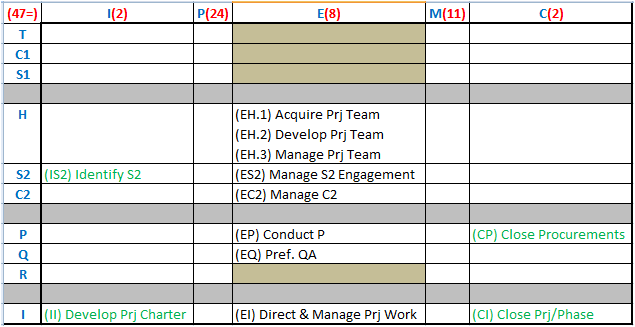
This image is an example of my one day's study where I started my PMP day with six A4 papers and fill in the keywords in 47 placeholders.

Mostly I would use single A4 paper for one day's studies and later I started using single big chart that's attached to fill in all clubbed up details under one big sheet for reference.

Reading or copying this sheet is of no use as that's only one way to to do the right thing..
With the process I am mentioning here you'll devise your own way to do it better.

Do you still call all 47 processes by their full names?
If yes, you're wasting your time. Once I know the full name, I can give them a short name and slowly my brain would start joining the short names with the full names. I write short name to save my time and call full name in brain as I will see full names in real world questions. 

So the first hint to make ITTO in 3 minutes is to write short names of 10 KA's, 5 PG's and 47 processes.

If you dunno what short names to give all these stuff. Pls read this -
http://withinaccess.blogspot.in/2014/11/the-47-processes-1st-headache.html

After you have short names for 10 KA's + 5 PG's + 47 processes, you can start with how to draw the process chart -
http://withinaccess.blogspot.in/2014/11/process-chart.html

please read above links only once and keep doing the stuff with paper and pen.. next time refer to only ur notes...else u'll not gain much from the processes mentioned here.

After about 3 times of making the process chart, you must be able to draw something like below image every time u start studying for ur PMP -
Initially, there could be mistakes, so make sure that process counts are right in each column as - 2-24-8-11-2 respectively.

let's talk in shortcuts now -
[It's good to count number of processes in each KA as well but only if you remember PG=P's count then also it's enough.. e.g.-P has 3-4-5-6 processes in C1,S1,R and T respectively..otherwise just 1...whenever it has more than 1, E's have none..E is 3 for H...hence there is none in it's M...M is 2 for I and S1...(hope u know which 2-2 are I and C)]

making above chart isn't enough...read aloud each of the short forms as their full forms .. use short forms only to write...never to call or recall

there could be no better description than Kim's study guide for beginners and no complete reference than PMBOK itself on ITTO..so for quick reference I had created an index for jumping to any of the processes I wished to -

I used same chart to create the index also
This is how I used that small chart for every little thing I did on a single day..

Get used to the chart and the short names and u ll save urself a lot of time and freedom from all sorta confusions

Wednesday, April 1, 2015

ITTO - excel

If you're looking for ITTO in spreadsheet, here's the link -

http://pmzilla.com/i-created-itto-5th-ed-spreadsheet

Hope this helps you, I did not use it though.

You can use it for -

  • memorizing ITTO
  • creating your shortcuts and to be sure you're covering complete stuff
  • answering PMP mock questions online during your preparations

Practice with PM's

I wish I knew it before I studied for PMP, nevertheless I'm sharing it here for you -

Know about - PMChallenge and PMwars?

Register on this site -
(or use FB/PMI credentials)
http://www.projectmanagement.com/

Although you can do many things there but from exam's perspective, you can answer questions on link -

http://www.projectmanagement.com/PMchallenge/

You can access above link without registering, but to keep track of your score and already answered correct questions, you must login with your own id.

To encourage yourself, you'll earn badges by answering some specific no. questions.

Tip - I use snipping tool to grab all wrong answers so that I can go through them later.

If you want to verify how you're doing you can get into PMwars and choose someone like you (novice at beginning and later a master). With PMwars you'll have to memorize answers so that you can score higher than your opponent. It's fun.

For PMwars you must login.


Team Building - Bruce Tuckman - 5 stages

In short -
The five stages of team development in a graph: forming, storming, norming, performing, and adjourning.
Dr Bruce Tuckman published his Forming - Storming - Norming - Performing model in 1965. He added a fifth stage, Adjourning, in the 1970s. 

Forming -
Team is formed..
Team begins to address ...

Storming -
place for conflicts, arguments ..
Every-time a new member joins the cycle of team building phases starts from here..

Norming -
Team begins to perform..

Performing -
Self-motivated, continuous performing stage..

Adjourning -
Emotional c-off..

Here's a good link to refer to -

http://www.businessballs.com/tuckmanformingstormingnormingperforming.htm

P.S.- Read again only italics this time. They will help you answer questions quickly.

For details, pl refer to other stuff as this article is helpful only for those who are aware of the concept and just wish to memorize it to be correct while choosing correct option in multiple choice question.

(Pl add any important keywords if I left)

Tuesday, November 11, 2014

Process Chart

Do you get confused about the activity names in the options to pick the right one?
Do you get confused in picking the right KA or PG for a given activity name or vice versa?
Do you get confused about how many processes per PG or KA?
Do you feel memorizing the Process Chart might help you?
Do you feel remembering the sequence of process could have helped you in some way?

Actually memorizing the process chart is not helpful in any of these as the headache of memorizing and heartbeats of recalling are not worth above questions...and with some days of studies you'll automatically get used to all of them.

If you still face issues, this post is for you...
Have you gone through below post for some other types of answers on verbs (PG) and nouns (KA)
We will extend similar shortcuts here and there are multiple references to above link.

Below is Kim's PG sequencing diagram -
As the Diagram says, the processes in 5 PG's have a proper sequence (1 to 4, green arrows and numbering)

But what if something is not made/built/implemented i.e. "E" as planned i.e. "P"? We will find out about such misses in "M" and need to return to "E" from there instead of closing "C". Hence the arrow 5

e.g.:- Perf. QA is an "E" process that's carried out before and after Control Q which is an "M" process.
So QA to QC arrow 3 and QC to QA arrow 5

What if Plan itself needs to be carried out once again? Plan could also be faulty or something was missed to be Planed and hence to be implemented subsequently? We will again find this out in "M" and the completed process will start from "P" this time. Hence the arrow 6.

e.g.:- An approved CR might require planning again so might follow arrow 6.
First time right deliverable will follow arrows 2-3-4 only.


Creating process chart in 7 steps-
*****************************
(This method will require 1-2 time revision to be able to draw it on ur own)

As we will study PG-wise, and #PG < #KA, its easier to draw..

Can you simply list out the PG's in columns and KA's in rows.. (sequence is given at link mentioned above)
PG seq - I,P,E,M,C
KA seq - TC1S1, HS2C2, PQR, I

(This KA sequence will also help in some internal sequencing you ll come across, so better don't divert from this one)


By now, you must be knowing there are total 47 process across 5 PG's (and 10 KA's but we are concentrating on PG-wise distribution)
So how many processes per PG?
2-2 in I and C (first and last PG's)
(2*2*2=) 8 in E (i.e. in middle PG)
('1'||'1'=11) in M
(8*3 =) 24 in P
Can you try to put the numbers like this by just remembering above description?


(Hope you still remember verbs and noun funda mentioned in above link)
For sequencing 47 processes we used format 
<PG><KA>[.#]


I and C - 
Just remember (2*2 =) 4 process names and place them against their KA's
Id (Identify) Stakeholder
Develop Prj Charter
Close Procurement
Close Prj or Phase


 E -

Don't take Risk of Executing TCS cuz of HR++

i.e. no R,T,C1,S1..means we have (10-4=) 6 KA's under column "E"
So please cross (or color) the boxes where you are not putting any process names.

As we know E has 8 processes cuz of double pluses in HR -
Now please put the numbering (in brackets) first..and then start writing the names -

Signature verb of this PG is Manage, (Direct & )Manage..

So you need to remember only these verbs -

H is "Acquired" (this verb is used only here in "E") and "Developed" (this verb is in "I" and "P" as well) both.
Procurement is "Conducted" (this verb is used only here in "E")
QA is "Performed" (perf. verb has been used in M as well once)
Do u also notice an "Engagement" after S2, it happens in "M" as well


M -

Signature verb of this PG is Control, M (Monitor & Control)..

Each KA is Monitored except H, cuz H had enough (++) in E already.
Lets color its box and don't put anything made-up of imagination here ;-P

So we should have (10-1=)9 processes in M whereas we have 11.

Cuz of IS1
i.e. I and S1 both have an additional processes making (9+2=) 11 processes in "M"
Those 2 additional ones are very imp too-

Validate S1 - (brings the Deliverable)
Perf. ICC - Integrated Change Control (digests the CR's to work upon)


Did you notice "Schedule" noun for "Time".
Remember no option with noun-"Time" or verb "Execute" is correct in exam.
What comes to your mind first when you hear "Time management" or "Execution" :? Nothing related to PMP, right?


P -
Now remains the biggest task
Distributing 24 among 10 KA's is difficult.

Lets distribute with partiality in this sequence and weightage -

This time take the Risk of doing so for TCS -

i.e. R-5,T-6,C-3,S-4. Just remember this as is
and number the sequences in the boxes

Name 1st processes in each KA as -
Plan <KA> Management.
Only for Time, KA is replaced with noun - Schedule


Now recall the nouns (and unique verbs) under each KA and don't forget the sequence of processes within the P PG -

Like for PC1.# -
First Costs of Activities are Estimated and then overall Budgeting is done.

Did you notice last P activities are also significant as they mostly create Baselines (T1C1S1-Cost, Schedule,Scope) or there's a repeated "Plan" verb where we actually work on Risks..

Also notice that the big colored boxes are not double in any row?
That's cuz if one KA has multiple processes in a PG, then it either skips some of the other PG's or has only 1 processes in other PG's
Also when u c a shortcut, do u read the full name? I do.

Can u try making this chart by urself once while reading and 2nd time by recalling the steps..third time u can do it on ur own.

Sunday, November 9, 2014

Some useful links

For some of the links you might need to register or avail the paid membership -

Do you wonder how the real documents look like, the ones mentioned throughout PMP study materials and books? May be they help you remember what do they contain when such a question is asked in the exam -

http://www.pmi.org/Learning/electronic-forms.aspx

Looking for tests or exam questions?
Do u know best way to prepare by questions is see - check the ans after each question and not doing this as a whole?
But for mock test of course you should try the whole test in a go before checking the ans.

http://pmi.books24x7.com/toc.aspx?bookid=55550 


Saturday, November 8, 2014

New lines of Communication

Considering we should solve a question in 1 minute and also by 1 read (to not to procrastinate later about time insufficiency); we should have some shortcuts for typical problems..

Suppose you have 3 new members added to a team of 7, and you gotta find out no.of communication channels added?
Are you gonna solve this way -
Formula = n(n-1)/2
Total members now = 7+3 = 10
10(10-1)/2 - 7(7-1)/2 = 5*9 - 7*3 = 45 - 21 = 24

Hope you found out a trick that there is a division by 2 but also two consecutive numbers in numerator as n and n-1 one of which is gonna be divisible by two..and you must perform division before multiplication as we gotta play with small numbers as much as possible..

Here's my real trick..the new formula ..

m(m-1)/2 +nm
m is added mem n is original mem

3(3-1)/2+3*7=3+21=24

I used the example so that you don't need to remember the formula..

Happy Calculating!